Why learning should be compulsory, but never a straight line: PDSA Spirals


I've written before clarifying how the Plan-Do-Study-Act (PDSA) cycles are used. See the article here.
The most important question to ask is:
Is it a test or a task?
And if the answer is a task, then PDSA it is not!
Iterative learning up the ramp
I also discussed the iterative nature of successive PDSA cycles testing the one change idea, heading up the PDSA ramp.
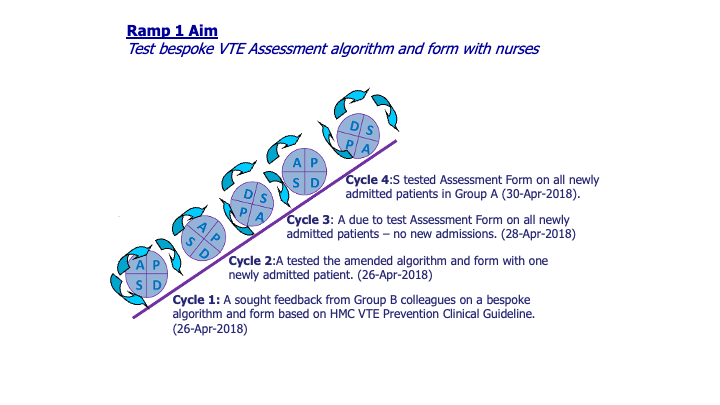
Often improvers make the mistake of subsequent PDSA cycles testing (or tasking) a different change idea, not building on the learning of the previous cycle.
There are always wrong but better models
However, this is only a model, and Professor George Box's comment comes to mind:
All models are wrong, but some are useful.
Considering the progression of successive PDSA cycles heading up a ramp implies each cycle leads to some improvement. However, this is not always the case. Our learning from a PDSA cycle is also likely to show no improvement.
And that is just as valuable for learning. Yet, we don't show the ramp going down!
Through discussions on PDSA during the 12 Days to Deming course (see my review here), our thinking progressed to considering PDSAs moving along a spiral. Why this works better as a model:
- Each PDSA cycle is connected to the previous cycle
- The spiral does not move in one direction
This more realistically represents the situation. A PDSA might lead to an improvement. That's a learning. Another might lead to no improvement or even a worsening. Again, that's learning. Each PDSA is associated with the others for a particular change idea.
Rather than illustrating the PDSAs as discrete circles on a ramp, a spiral seems to reflect the model much better:
PDSA cycles as a spiral (LLM-generated after a few false start prompts)
Here the change idea is tested through successive PDSAs. They remain associated with each other as it is the same change idea, hence the single, continuous line.
The measure studied during each cycle either demonstrates improvement, no change or a worsening. Regardless, there is continual learning.
What isn't illustrated (perhaps my next version) is the building confidence once tests consistently produce improvement. Moving from one employee on one day to more employees and then on more days as an example.